WWF Training Hub
Welcome and thank you for joining the race to save our world. No matter how fit you are, you will find your training plan and support here.


Running With Us
WWF-UK has teamed up with Runningwithus, a team of endurance coaches with over 40 years collective experience coaching runners and triathletes from elite, club athletes, emerging juniors as well as those undertaking events for charities. Their training plans, advice, tips and articles can be seen across the UK and European national and trade press.
Anytime you need any help with your;
- Running
- Training
- Nutrition
- Strength
- Conditioning
- Injuries
- Recovery
Please email them at info@runningwithus.com and they will get back to you within 48 hours.
In the sections below you will find training plans for different distances and fitness levels.
Getting to the core
Think of your core as the chain that holds your body together, essentially your body without arms and legs. This is important because having a strong core doesn’t just mean having a nice six pack. Core muscles also include your obliques, your pelvic muscles, your hip muscles, the muscles around your lower and middle back, your chest, and even your diaphragm – yes that’s right, the muscle that helps you breathe – so crucial for running then! A stronger core will see you running faster times with reduced risk of injury, and it doesn’t need to mean hours spent in an over-priced, sweaty gym.
The simple core routine below performed regularly will help develop stability and balance in your running stride and improve your posture to help with your running efficiency. Over coming weeks and months we will give you more advanced workouts to try, but we would consider the 6 exercises below a great start point for all runners.
Perform all the following exercises 3 times and aim for 2-3 sessions a week.
-
 © Running With Us
The Finger Crusher
A crucial and underutilised exercise, this small core engager will reap big rewards.
Breaking it down
Lie on a mat in a sit up position, find the natural arch in your back, place your hands under this arch, engage your lower abs and pelvic floor and pushing your spine down on to your hands, trying to crush your fingers. Aim to keep the pressure applied evenly to your fingers for at least 30 seconds.Muscles strengthened
The multifidus – the tiny but crucial muscles that stabilise the spine and the pelvic floor which provides support to all your pelvic organs, and the transverse abdominus which stabilises your core.Stepping it up
Add small alternate leg lifts, while keeping the pressure on your hands even. -
 © Andrea Piacquadio / Pexels
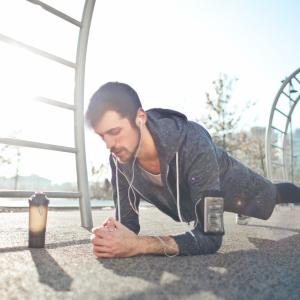
Plank Routine: front plank – side plank – side plank
The plank in all its forms is an essential runner conditioning exercise, helping you to keep your posture through each stride, especially when tired.
Breaking it down
Start with a front plank - lie on your front and raise your body up on your elbows with your forehead over your hands. Keep a straight line from the neck down through the legs to your ankles; engage all your core muscles by sucking your belly button up to the ceiling. Try to imagine lengthening your body out form the shoulders forwards and heels backwards, as well as lifting through the mid-section.Now move into a side plank - Make a right angle with your supporting arm, roll your body onto this arm keeping your other arm above your head, keep your feet together and your stomach strong. Rise up, lifting your hips, making sure you squeeze your glutes, pushing your pelvis through. Repeat on the other side by rolling through to your other elbow. Aim to build up to holding each pose for 45 seconds or more.
Muscles strengthened
Erector spinae, which helps to straighten your back, your abs, chest, and your transverse abdominus. In addition to these, the side plank helps to develop your obliques.Stepping it up
Make your front plank more challenging by alternately legging each leg from the floor by 5 or 6 inches whilst trying to keep you core strong and hips level. Progress your side plank by lifting your top leg whilst maintaining your hip position. -
 © Running With Us
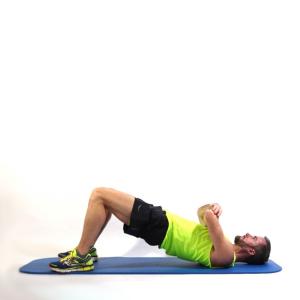
Bridge
The glutes are your big running propulsion muscles. The bridge helps to engage this crucial engine whilst also developing hip and spine stability.
Breaking it down
From a sit up position, keep your stomach strong, engage your glutes and push your hips up to keep a straight line from your shoulders, through your hips to your knees. Keep your hips high by squeezing your glute muscles. If you find your hamstrings working more than your glutes, tuck your feet a little further under towards your backside.Muscles strengthened
The bridge principally works your gluteal muscles that extend your hips but also develop your rectus abdominus and transverse abdominus.Stepping it up
Once in a strong bridge position try extending one leg out straight from the knee, without letting your hips drop! -
 © Ketut Subiyanto / Pexels
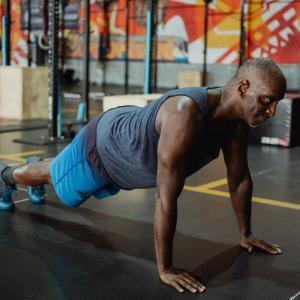
Press Up
Quite simply one of the best exercises you can do. Having the stability benefit of the plank the press up also conditions your upper body....why is this important? – you’ll swing your arms well over 35,000 times during a marathon!
Breaking it down
Place your hands a shoulder and a half’s width apart, get into the plank position, but with your knees touching the ground and feet off the floor, lower your chest to the floor and push back up, not just pushing through your chest and arms, but also through your core. Push yourself until your feel you could only complete 1 more repetition without failing.Muscles strengthened
The press up is a fabulous full body exercises because in addition to working all the muscles used in a plank your also develop your pectoral and tricep muscles in your arms which play a crucial role in providing power and balance in your running stride.Stepping it up
Go full body! Instead of placing your knees on the floor complete your press up whilst holding a full plank position but maintain the depth of your press up. This dynamic full body exercise is all about the legs, it also helps develop core stability and control as well as hip alignment. -
 © Anna Shvets / Pexels
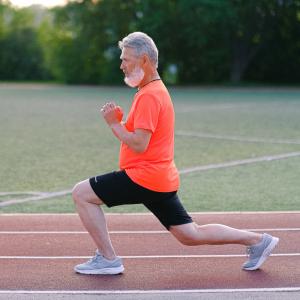
Walking Lunge
This works all the key the running muscles in a fantastic full chain movement. Control and alignment are crucial so don’t rush this one!
Breaking it down
From a tall standing position, step forward into a lunge position, keeping your back heel lifted, with hands on hips, and squeezing the glute of your rear leg. Bend each knee to 90 degrees. Work to keep your upper body tall and shoulders back, your knee should not be over the front of your toes. From the lunge position squeeze the muscles of your front leg to get back to the standing position before stepping forward into another lunge with the opposite leg. Work to minimize any poor balance by focusing on a good alignment with toes, hips and chest all pointing forwards. Complete between 5 and 10 steps with each leg.Muscles strengthened
The walking lunge is incredibly effective because not only does it work both the key anterior and posterior muscles of the legs (quads, glutes, hip flexors, and hamstrings) evenly it also requires excellent core stability through your transverse abdominus and erector spinae.Stepping it up
Holding a weight such as a medicine ball directly out in front of your body, step into your lunge before turning your upper body from the hips over your front leg, bring your arms back to the centre before moving into your next lunge. -
 © Running With Us
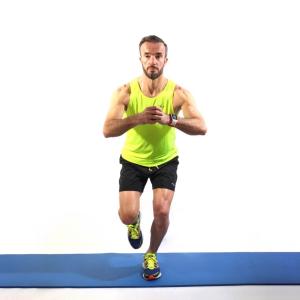
Single Leg Squat
It’s all about specificity with this one - engaging all the muscles that move you from one stride to the next the single leg squat strengthens your body whilst mimicking and exaggerating the movement.
Breaking it down
Stand on one leg, engage your glute on your standing leg, keep your hips facing forward and aligned with your knee and toe. Imagine sitting back onto a chair and bending your knee to lower your body towards the ground. You don’t want your knee to roll inwards, so go down as far feels comfortable and before your knee would lose control. Aim for 8-12 repetitions on each leg.Muscles strengthened
The powerful leg muscles – quadriceps, hamstrings, and calf muscles. The real advantage though of the single leg squat is that it requires the balance provided by your gluteus maximus and abs as well as your erector spinae – a true full body exercise. By ensuring your knee does not 'collapse inwards' you will also be learning to control and engage your glute medius muscle.Stepping it up
Try your singe leg squats on a balance board or BOSU ball to take away stability – but keep that focus on form!
/

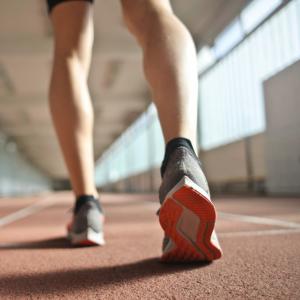
Choosing the right marathon shoes
It goes without saying if you are going to pound tarmac for 26.2 miles you need to be
confident you are giving your feet the tools they need to perform. Choosing a perfect
race shoe is very much a personal choice but here are some key points to consider
helping you choose between the dizzying array of options on the market.
-
 © Andrea Piacquadio / Pexels
How do you roll?
Knowing how your body moves and how your foot strikes the ground when you run should be central when buying race shoes. Whether you heel strike or mid or forefoot strike, whether you have neutral gait or whether you pronate (roll inwards) or supinate (strike on the outside of your foot) will affect the amount of cushion or support your require and feel comfortable in.
Try this – Take yourself down to your local running shop and ask for your gait to be analysed prior to making your purchase. You might be surprised at the level of experience and expertise on offer – many running stores are staffed by top class club runners who can really help you understand what you need.
-
 © Greg Rosenke / Unsplash
Hidden dangers
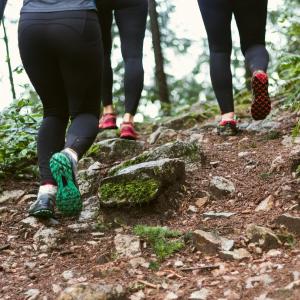
Knowing when to purchase a new pair of shoes can be a tricky business. If you are one of those folks who wait until you can feel the tarmac on the soles of your feet or the mud flowing in as the holes open up like a geological case study, the chances are you have been risking injury for several hundred miles. The cushioning in your shoes loses its density and effectiveness some time before their soles wear out enough for you to notice.
Try this – Look back over your training plans and logs if you have put 400-500 miles through your shoes, they will thank you for gracefully retiring them!
-
 © Greg Rosenke / Unsplash
Find some space
Whilst we all like a shoe that fits like a glove be aware that your feet will swell through the course of a marathon increasing your chances of blisters and cramping.
Try this – Shop for your shoes on after a short run or at the end of the day when your feet have swollen through the course of the day. Wear your usual running socks and give yourself about 0.5-1cm of space between the end of your big toe and the end of the shoe. Consider replacing the laces with elasticated laces which keep your feet to snug whilst allowing the upper of your shoes to expand as your feel swell.
-
 © Dulcey Lima / Unsplash
Minimalism
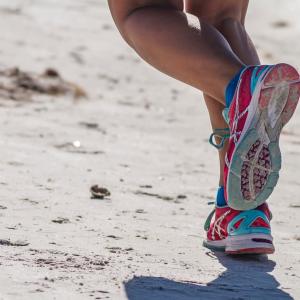
The degree of support and cushioning you need in a marathon will be different to what you need in a 5km race. The shoe market has come on and you have a huge range of choices from all out 0 degree drop racing flats, to heavily cushioned rubber bricks. There may be many benefits of wearing a flatter, more minimalist shoe, but a lower profile shoe can also put more strain on your achilles and calf muscles. Even if you are a forefoot striking gazelle most runners' form tends to suffer in the later stages of a marathon leading to a heavier, more heel focused foot strike.
Try this – A relatively lightweight shoe can be an advantage when racing but don’t compromise on the support and cushioning you need as an individual runner. If you are looking towards a lighter, or more minimal shoe give yourself time to adapt before trying to race in them. It’s always better to go for extra comfort, cushioning and support on marathon day as the last 10 miles are hard enough without the feet and lower limbs suffering due to a lack of shoe support.
-
 © Arek Adeoye / Unsplash
Finding your sole mate
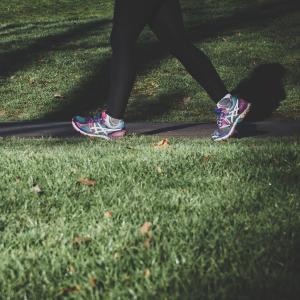
So, you have your awesome red and black racing kit. You know you’ll be fast because it’s red and black right? All you need to top it off is matching shoes and you’ll be on fire! Sadly, though blisters and aching calf muscles can ruin the best of looks!
Try this – It’s all about the fit! Put comfort at the top of your list when purchasing a marathon shoe, which is more important than the brand and whether you look suitably coordinated. If a shoe doesn't feel 100% comfortable when you try it on then don't wear it in the marathon, it could kill your race!
-
 © Alexandr Podvalny / Unsplash
Getting to know one another
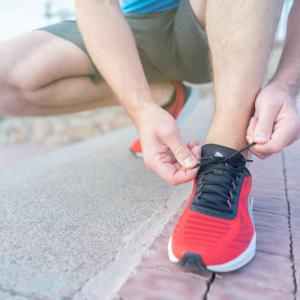
Marathon expos are wonderful - you get to try loads of great kit and pick up bargains! Now is not the time, though, to be getting your race shoe – and I have seen it done! You need to gradually break your new shoes in and allow the cushioning and uppers to relax before you are ready to race in them.
Try this – Give yourself enough time to get 50-60 miles into your race shoes before marathon day. Wear them on a long run and during a couple of your marathon-paced sessions.
/
Preparing for the big day
In this section you will find useful advice for the final stage of your epic challenge such as tapering or the final training runs and top tips for your big day. Click on the buttons below to download the information. If you have more questions to be answered, our coaching partner, Runningwithus is always on hand to support you with any queries.
Good luck with your final preparations!