

Mountain gorilla: Around 1,063 remain

Can be found: Africa

Threats: Habitat loss, human diseases, mining

Mountain Gorillas (Gorilla Beringei Beringei)
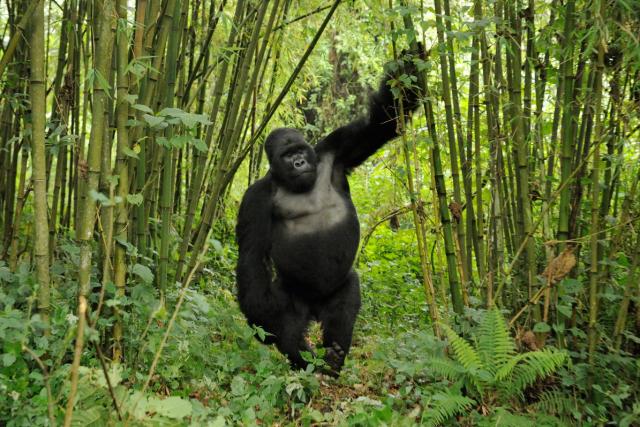
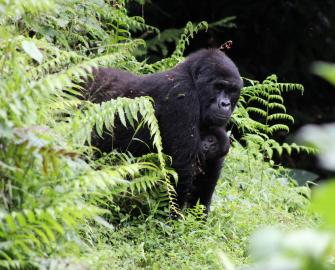
These great, glorious, fur-coated apes are some of our closest relatives. Sadly, we may also be their biggest threat. People have been pushing into the mountain gorilla’s forests in central Africa for decades – now there are only about 1,000 of these splendid beasts in the wild.
Mountain gorillas generally live in groups of several females with their young and usually one dominant adult male – known as a ‘silverback’ because of the patch of silver hair on his back and hips.
The main threat to mountain gorillas is people and the associated increasing pressure on their habitat. With so few individuals in the wild the mountain gorilla is listed as endangered. The good news is, their numbers have recently been rising. It’s not too late for us to protect our mighty mountain cousins.
Why are they so important?
Mountain gorillas, like all wild animals, play an important role in their environment. Without these large-scale grazers eating lots of vegetation, the natural balance in the food chain would be disrupted. This could negatively affect other wildlife in the area, and ultimately the people who depend on that environment for food, water and other resources.
Ecotourism – socially and environmentally responsible tourist visits, including carefully guided trips to see gorillas – can also be an important source of income for local people living in close proximity to wild mountain gorillas.
Key facts
What is the habitat of a mountain gorilla?
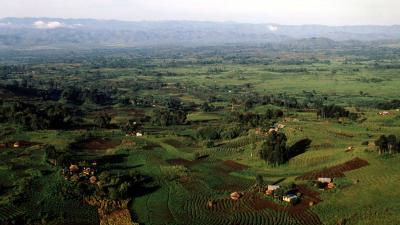
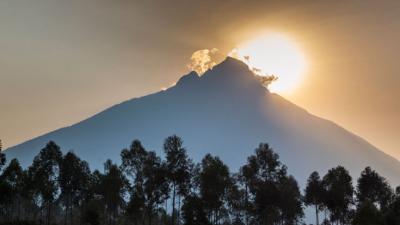
Mountain gorillas live in high altitude montane and bamboo forests at 2,500 - 4,000 metre elevations[1] - far higher than any mountain you would find in the UK.
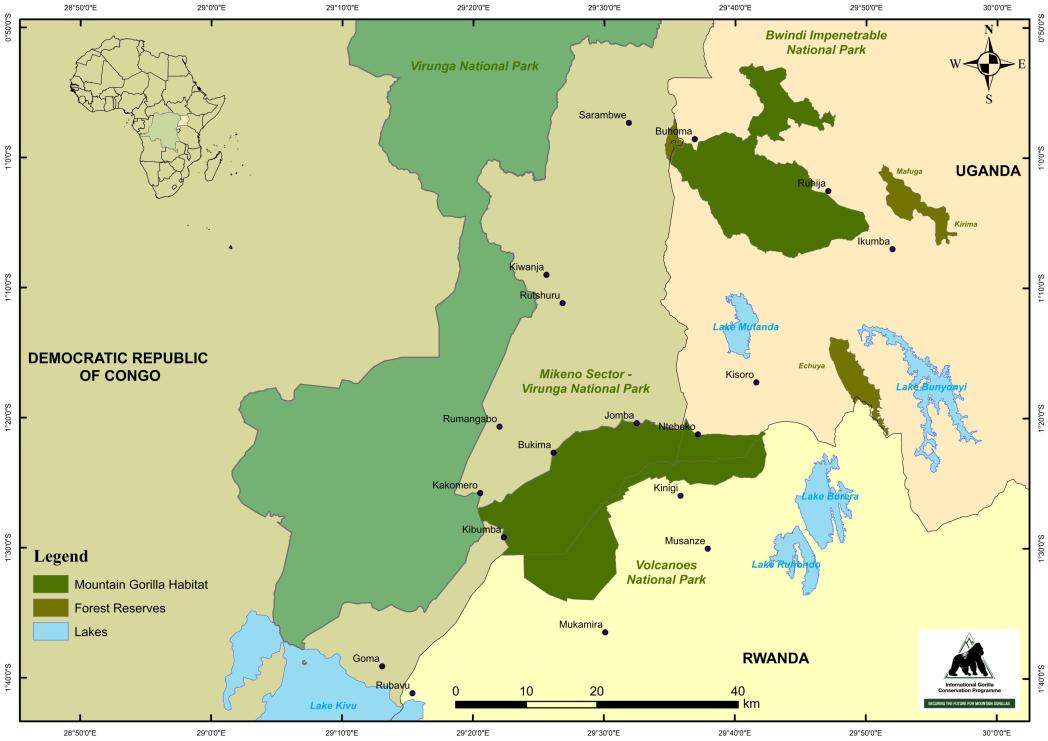
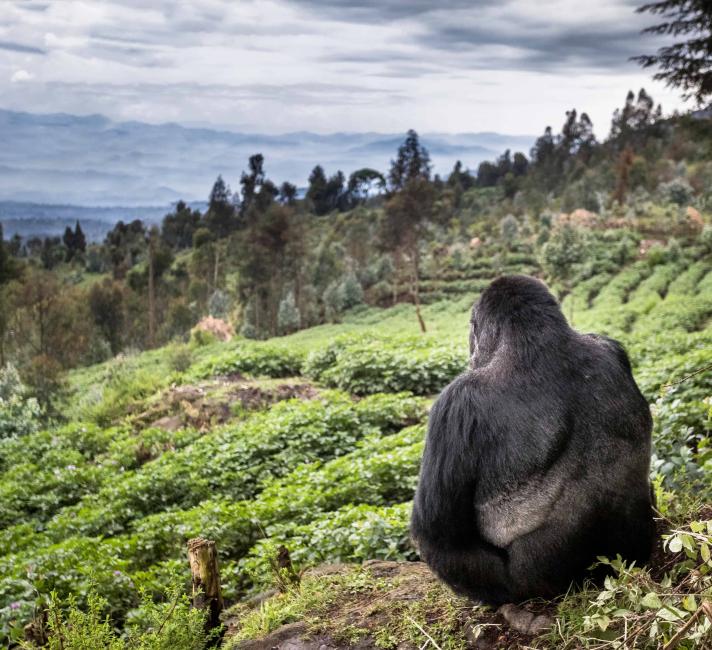
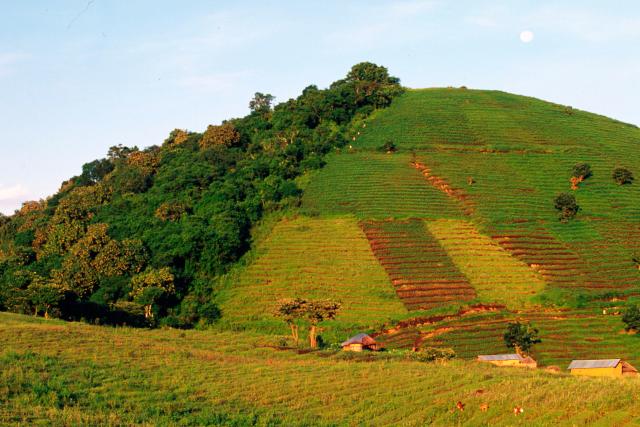
They live in just two isolated sub-populations – one in the Virunga volcanoes and one in Bwindi Impenetrable National Park, which is connected with Sarambwe Nature Reserve. Mountain gorillas are restricted to around just 2,294 sq km (similar to the size of Nottinghamshire) and both sub-populations are completely surrounded by human settlements or agriculture, preventing them from expanding their range.[2]
How many mountain gorillas are left?
Mountain gorillas are the only great apes in the world that are believed to be increasing in population[3]. Mountain gorillas in the Virunga volcanoes are one of the best monitored of all great ape populations, with some groups being studied since the late 1960s, and the sub-population has been censused since the 1970s.[4]
There are at least 604 mountain gorillas in the Virunga volcanoes, up from an estimated 480 in 2010.[2] In the Bwindi-Sarambwe ecosystem, there are at least 459 mountain gorillas, up from an estimated 400 in 2011.[5] This means there are approximately 1,063 mountain gorillas in total.[1]
More than 70% of mountain gorillas are habituated (used to the presence of people). Interestingly, mountain gorillas and humans share around 98% of their DNA.[6] Like the human fingerprint, each gorilla can be distinguished by their nose - which has a unique pattern.
How big are mountain gorillas?
The biggest and most powerful living primate can weigh over 180kg as males and about 90kg as females.[7]
For context, adult human beings often weigh around 70kg.
Under their dark brown to black fur, mountain gorillas have black skin.[8]
What do mountain gorillas eat and drink?
About 85% of a mountain gorilla's diet is made up of leaves, shoots and stems. They have been known to eat larvae, snails and ants, and spend about a quarter of their day eating.[9]
Roots, bark and rotting wood are also eaten by mountain gorillas as good sources of sodium. And they sometimes drink rain by extending their lower lip to catch it when it falls.[8]
What is the IUCN status of mountain gorillas?
There are an estimated 1,063 wild mountain gorillas, and they are categorised as endangered (which is between critically endangered and vulnerable). This means they face a very high risk of extinction in the wild.
What are the different types of gorilla?
There are two gorilla species: the eastern gorilla and the western gorilla.
Each species is further divided into two subspecies, so four gorilla subspecies in total.
The eastern gorilla (Gorilla beringei) has subspecies of the mountain gorilla (Gorilla beringei beringei) and the eastern lowland gorilla (Gorilla beringei graueri), while the western gorilla (Gorilla gorilla) has subspecies of the western lowland gorilla (Gorilla gorilla gorilla) and the cross river gorilla (Gorilla gorilla diehli).
How long do mountain gorillas live for?
Gorillas can live for more than 40 years in the wild[8]. They are classed as infants until around 3.5 years old and adults from around 8 years. Females will normally have their first infant between the ages of 10 and 12.[9]
Around half of mountain gorillas leave their birth group and join other gorilla groups or start their own.[10]
Where do mountain gorillas live?
Below you can see a map of mountain gorilla habitat.
The map covers parts of the Democratic Republic of Congo, Uganda, and Rwanda - only a small portion of which mountain gorillas live, marked in dark green. This shows the mountain gorillas of the Virunga volcanoes and the Bwindi Impenetrable National Park split into two isolated sub populations.
-
 © naturepl.com / Christophe Courteau / WWF
 -
 © Andy Isaacson / WWF-US
 -
 © WWF-Canon / Martin HARVEY
 -
 © @naturepl.com / Christophe Courteau / WWF-Canon
Fighting the illegal wildlife trade
This unique project between 2024 and 2027, supported by the UK Government’s Illegal Wildlife Trade Challenge Fund, strengthens efforts to address the illegal wildlife trade across Uganda, Rwanda, and the Democratic Republic of Congo.
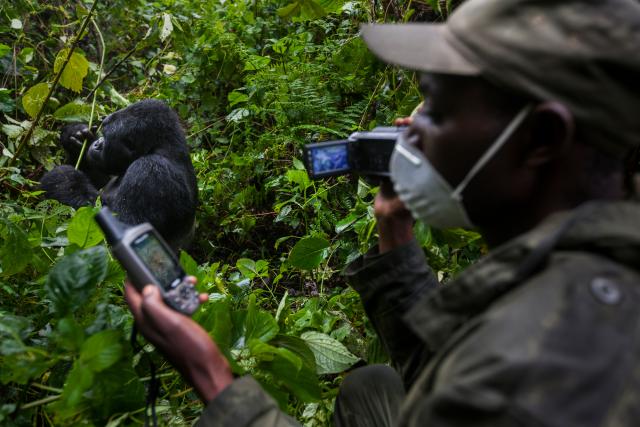
Through this project, we’re supporting protected area rangers to build their skills in gathering data and monitoring wildlife and threats, using enhanced technology software and tools. In parallel, we’re helping to improve information sharing and communication on the illegal wildlife trade across the Greater Virunga Landscape, crucially including local people and knowledge – leading to improved ability to tackle cross-border illegal wildlife trade.
By bringing together protected area authorities, law enforcement agencies, and local communities, while helping to build their capacity and strengthen coordination and cooperation, we aim to achieve zero poaching of key species and an overall reduction in illegal wildlife trade incidences in the Greater Virunga Landscape.
Protecting habitats, reducing disease
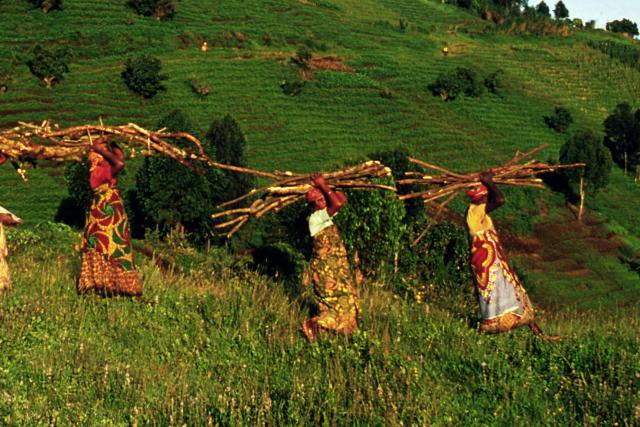
Working with the International Gorilla Conservation Programme and local communities, the Trillion Trees Reforest Fund is supporting the planting of at least 20,000 trees, restoring community areas around the famous Bwindi Impenetrable National Park, home to around half the world’s remaining mountain gorillas.
As they grow, these trees will provide increased natural resources (e.g. firewood, food, herbal medicine) outside of projected areas, reducing the need to illegally enter protected mountain gorilla inhabited forests. This helps to reduce habitat degradation, the likelihood of spreading of human diseases to the gorillas, and the poaching of other wildlife.
Restoring trees to community farms will also strengthen local livelihoods by providing more sustainable access to natural resources and improving community resilience to the effects of climate change.
Eco-tourism initiatives
We’re supporting sustainable eco-tourism initiatives, to help protect the landscape and mountain gorillas and benefit local communities.
In addition to creating increased employment opportunities in the tourism sector, we’ve helped to introduce mechanisms, such as revenue sharing schemes, to ensure that local people benefit directly from this tourism. Profits from a range of sustainable tourism activities are ploughed back into the community via a diverse range of enterprises, helping to reduce poverty pressure and create financial incentives for conservation efforts.
Mountain gorilla tourism is responsibly managed so that risks are minimised. For example, taking adequate precautions against disease transmission given that, due to their genetic similarity, mountain gorillas are highly vulnerable to human diseases.
Adopt a Mountain Gorilla
Adopt a Mountain Gorilla
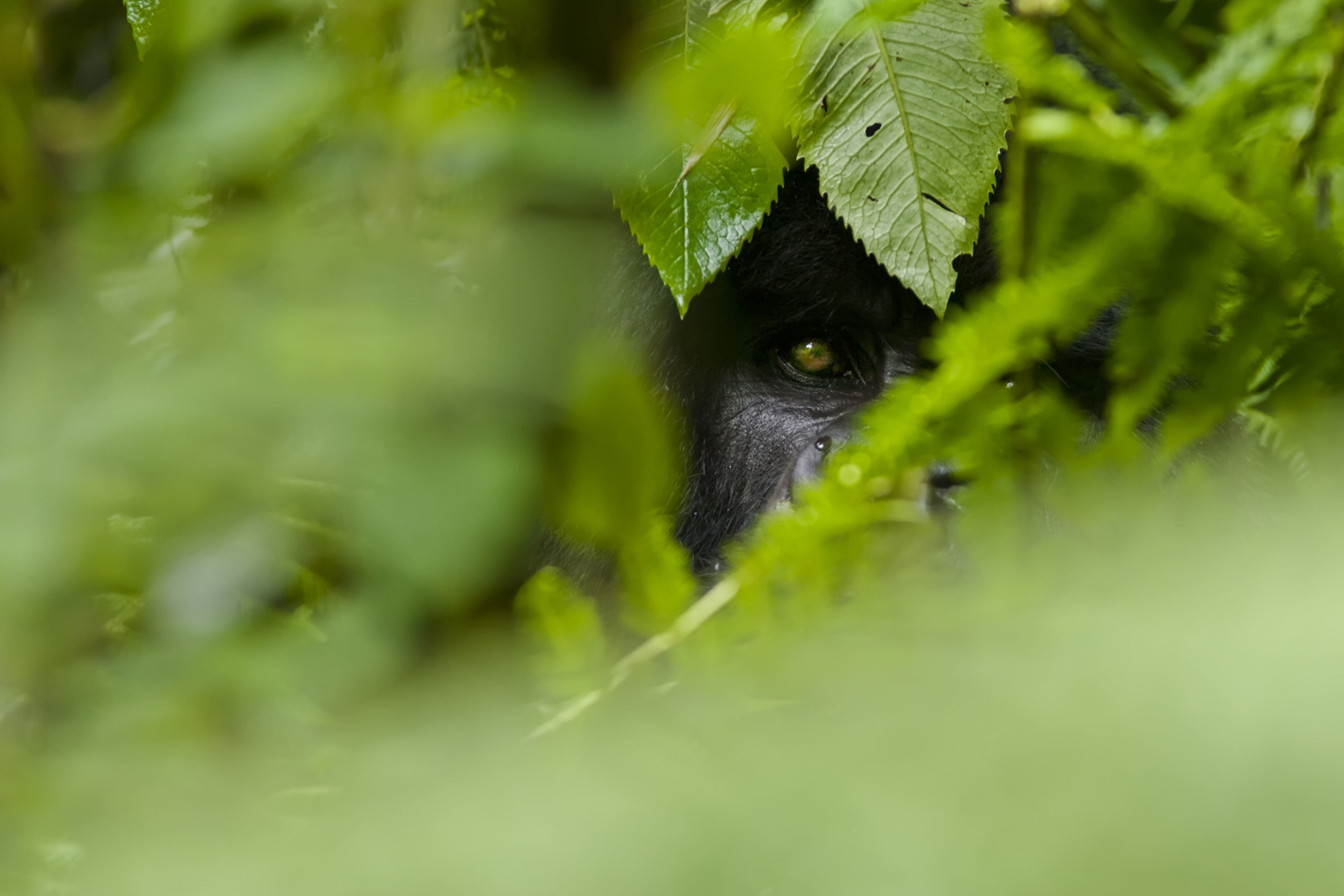
Adopt a mountain gorilla as a gift for a loved one. Choose between a welcome pack for an adult or a child, and they'll get an exclusive WWF cuddly toy, regular stories about mountain gorillas, and other goodies!
We also recommend

Go Wild - WWF's Club for Kids
10 facts about mountain gorillas
Take a mountain gorilla quiz
World Gorilla Day
Sources
- Wilson, D.E. and Mittermeier, R.A. (2009) Handbook of The Mammals of the World: Primates
- Granjon, A.-C. et al. (2020) Estimating abundance and growth rates in a wild mountain gorilla population. Anim. Conserv. 23, 455–465
- 1) Granjon, A.-C. et al. (2020) Estimating abundance and growth rates in a wild mountain gorilla population. Anim. Conserv. 23, 455–4652) Guschanski, K., Vigilant, L., McNeilage, A., Gray, M., Kagoda, E. and Robbins, M. M. (2009) Counting elusive animals: comparison of a field and genetic census of the entire population of mountain gorillas of Bwindi Impenetrable National Park, Uganda
- https://whc.unesco.org/en/soc/3847 Accessed 11/01/25
- Hickey, J.R., Uzabaho, E., Akantorana, M., Arinaitwe, J., Bakebwa, I., Bitariho, R., Eckardt, W., Gilardi, K.V., Katutu, J., Kayijamahe, C., Kierepka, E.M., Mugabukomeye, B., Musema, A., Mutabaazi, H., Robbins, M.M., Sacks, B.N., and Zikusoka, G.K. 2019. BwindiSarambwe 2018 Surveys: monitoring mountain gorillas, other select mammals, and human activities. GVTC, IGCP & partners, Kampala, Uganda, 40p.
- IGCP. OVER 30 YEARS OF IMPACT IN MOUNTAIN GORILLA CONSERVATION. 2024 https://igcp.shorthandstories.com/30-years-impact-report/index.html
- IGCP Factsheet July 12 International Gorilla Conservation Programme Website.
- Hickey, J.R., Basabose, A., Gilardi, K.V., Greer, D., Nampindo, S., Robbins, M.M. & Stoinski, T.S. 2020. Gorilla beringei ssp. beringei (amended version of 2018 assessment). The IUCN Red List of Threatened Species 2020: e.T39999A176396749. https://dx.doi.org/10.2305/IUCN.UK.2020-3.RLTS.T39999A176396749.en. Accessed on 11 January 2025.
- https://igcp.org/mountain-gorillas/ Accessed 11/01/25
- Ruvolo, M. 1997. Molecular phylogeny of the hominoids: Inferences from multiple independent DNA sequence data sets. Mol Biol Evol, 14, 248 - 265 as seen in WWF Species Action Plan 2010-2014 Feb 2010
- Morrison, R. et a;, (2020) Inter‐group relationships influence territorial defence in mountain gorillas Journal of Animal Ecology https://doi.org/10.1111/1365-2656.13355