

Emperor penguin:
Around 595,000 adults in the wild

Can be found:
Antarctica

Threats:
Climate change
What sound do emperor penguins make?
Emperor penguin song
Emperor penguin
(Aptenodytes forsteri)
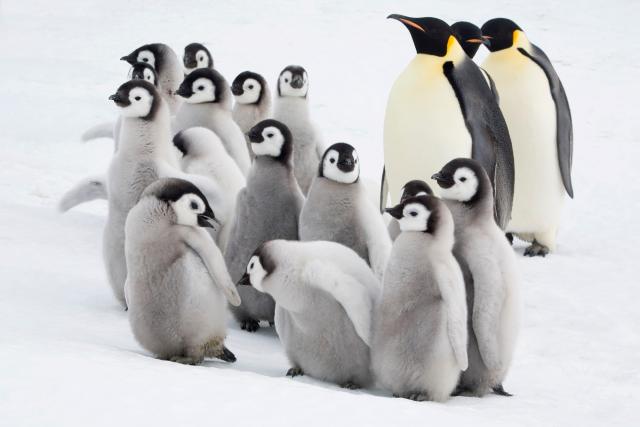
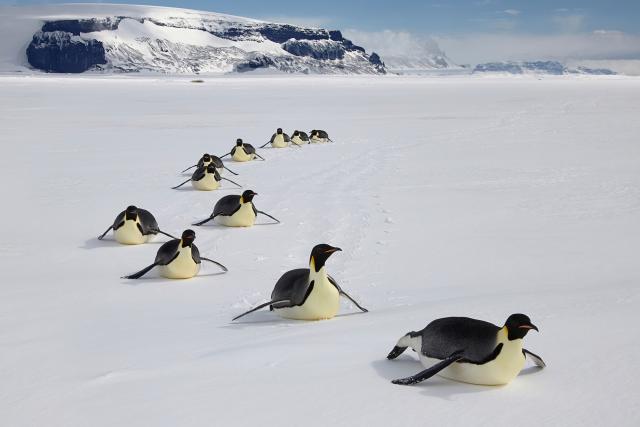
The emperor is the largest living penguin species standing around 120cm tall. They might look a bit clumsy on land, but penguins are brilliant swimmers. Emperor penguins have the deepest and longest dives of any bird, often reaching depths of over 200 metres. One bird has been recorded at a depth of 565 metres.[1]
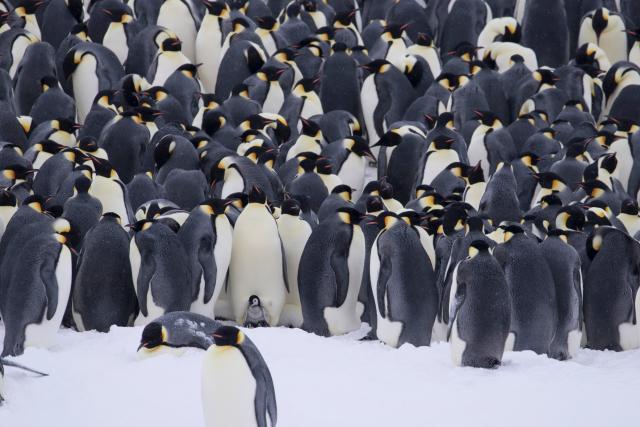
Emperors are well adapted to thrive in the freezing conditions of the Antarctic. To preserve heat, they have a dense double layer of feathers – about 70 feathers per square inch – large fat reserves and, proportionally, smaller beaks and flippers compared to other penguins. This all helps prevent heat loss. They also work together to keep warm by huddling up in large groups, shuffling round so each gets a turn in the warm centre.
Populations have declined by almost a quarter since 2009 in a key sector of Antarctica[2] and one colony off the Antarctic Peninsula has disappeared completely.[3] The biggest threat to them right now is climate change due to changes in the sea ice they depend on.
Why are emperor penguins important?
Emperor penguins are a vital part of the Antarctic food chain – they eat creatures like squid and small fish, and are an important source of food for predators like leopard seals and large sharks. They also are a key indicator for climate change and ocean patterns.
By protecting emperor penguins we’re helping look after their ocean environment, which is good for all the wildlife that depends on it.
Key facts about emperor penguins
What habitat does an emperor penguin live in?
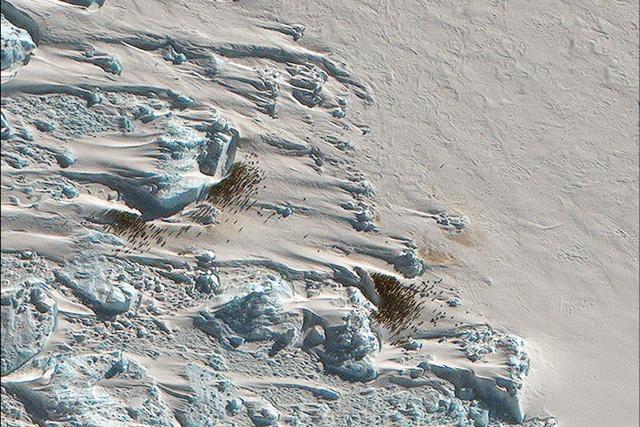
Emperor penguins live in frozen environments. There are 66 colonies located around the entire coast of Antarctica.[4] Half have been found by satellite and many have never been visited by human beings.
How many emperor penguins are there in the wild?
There are around 595,000 adult emperor penguins in the wild.[5]
How big is an emperor penguin?
Emperors are the largest living penguin species, standing around 110-130cm tall, that’s nearly 4ft! Their weight fluctuates throughout the year and ranges from 23-45kg.[6]
What does an emperor penguin eat?
Emperor penguins feed on a mixture of small Antarctic silverfish, squid, other fish and Antarctic Krill.[7]
What is the IUCN status of emperor penguins?
Emperor penguins are classified as 'endangered' on the IUCN RedList.[8]
Where do emperor penguins live?
Explore the map below to see the IUCN (International Union for Conservation of Nature) range data for emperor penguins.[9]
-
 © Wim van Passel / WWF
How we’re helping
Penguin adoptions support our partners at British Antarctic Survey to scour satellite images to find and track emperor penguin populations. Recently, the search resulted in the discovery of four previously unrecorded breeding colonies, as well as the rediscovery of one believed to have vanished.
Despite some positive news, predictions for the emperor penguins’ future remain stark. If ice loss continues, where will these Antarctic icons go? With your support, we can closely monitor how penguins are responding to their changing home, and use our findings to push for global action to slow climate change and buy them more time.
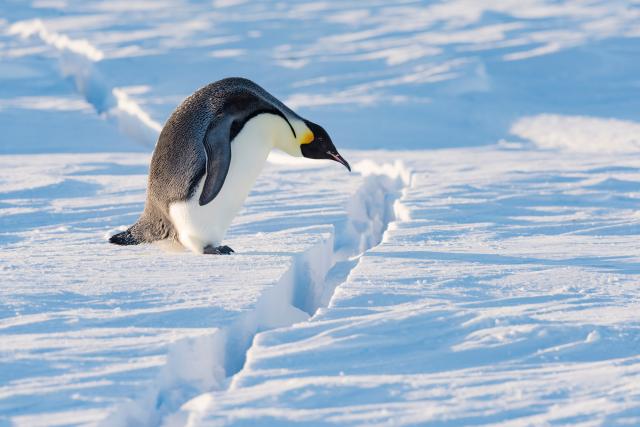
Endangered Emperor Penguins: WWF's Commitment To Rewriting Their Story
WWF & The British Antarctic Survey (BAS), working together, are determined to change the trajectory of emperor penguins' story.

Adopt a Penguin
Adopt a Penguin
Your adoption will help protect penguins in the Antarctic and help fund our vital work around the world.
We also recommend
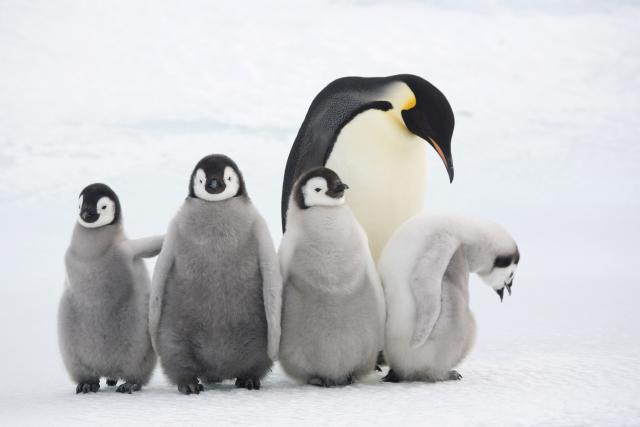
10 Facts about emperor penguins
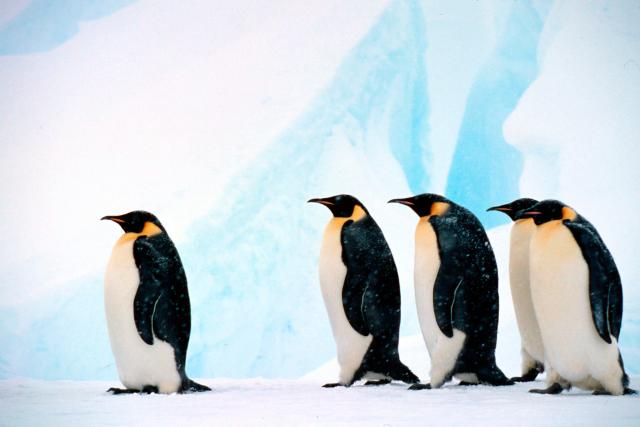
Test your penguin knowledge

Go Wild – WWF’s Club for Kids
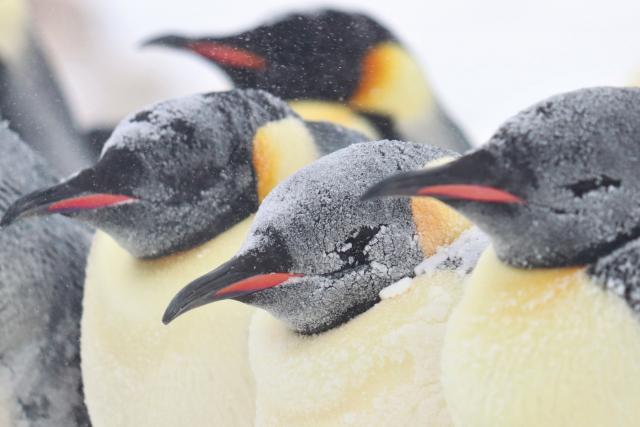
Penguin awareness day 2026
Sources
- First Recorded Loss of an Emperor Penguin Colony - British Antarctic Survey - News https://www.bas.ac.uk/media-post/first-recorded-loss-of-an-emperor-penguin-colony/ Accessed on 16/01/2026
- BirdLife International. 2020. Aptenodytes forsteri. The IUCN Red List of Threatened Species 2020: e.T22697752A157658053. https://dx.doi.org/10.2305/IUCN.UK.2020-3.RLTS.T22697752A157658053.en. Accessed on 11/04/25
- Trathan, P. N.et.al. 2019. The emperor penguin - Vulnerable to projected rates of warming and sea ice loss. Biological Conservation: doi: doi.org/10.1016/j.biocon.2019.108216
- BirdLife International. 2020. Aptenodytes forsteri. The IUCN Red List of Threatened Species 2020: e.T22697752A157658053. https://dx.doi.org/10.2305/IUCN.UK.2020-3.RLTS.T22697752A157658053.en. Accessed on 09/04/26
- Regional emperor penguin population declines exceed modelled projections | Communications Earth & Environment https://www.nature.com/articles/s43247-025-02345-7 Accessed on 16/01/2026
- Projections of future population decline indicate the need to designate the emperor penguin as an Antarctic Specially Protected Species. Information Paper submitted by SCAR April 2021
- Emperor penguins diving and travelling – Australian Antarctic Program https://www.antarctica.gov.au/about-antarctica/animals/penguins/emperor-penguin/how-deep-can-they-dive/ Accessed on 16/01/2026
- Global Change Biology | Environmental Change Journal | Wiley Online Library https://onlinelibrary.wiley.com/doi/full/10.1111/gcb.15806 Accessed on 16/01/2026
- BirdLife International and Handbook of the Birds of the World (2016) 2007. Aptenodytes forsteri. The IUCN Red List of Threatened Species. Version 2025-2 https://www.iucnredlist.org/species/22697752/157658053 Accessed on 19 January 2026
- New emperor penguin colony discovered. 20 January 2023 British Antarctic Survey Press Release https://www.bas.ac.uk/media-post/new-emperor-penguin-colony-discovered/ Accessed on 20/01/2026