
War, Energy and the Cost of Food: The Urgent Need to Transform Our Food System – Part 1
Accurate at time of publication: 21 April 2026
Geopolitical volatility is unavoidable, but transforming how our food is produced, distributed, and consumed can help build resilience and protect long-term food security.
In this two-part article, we take learnings from the clean energy transition to explore how we might transform and build a better food system - based on what, where and how food is produced.
The war in the Gulf is first and foremost a human catastrophe, with profound and lasting impacts on the lives, livelihoods and futures of those caught up in its path.
Its consequences are also being felt far beyond the conflict zone, as rising energy and petrol prices place additional strain on households already struggling with the cost of living, adding further impetus to the shift towards domestic renewables and much‑needed energy security. As the UK Climate Change Committee noted in March, reaching net zero would cost less than a single fossil‑fuel price spike and went on to emphasise how “in light of current world events, it’s more important than ever for the UK to move away from being reliant on volatile foreign fossil fuels, to clean, domestic, less wasteful energy.”
Equally painful for consumers and those in the business of producing food, is what is likely to happen to the price of food, depending on how long the conflict lasts.
It’s not just gas and oil passing through the Strait of Hormuz. About one third of the world’s fertilisers also pass through this route. Fertiliser prices are spiking, just as the planting season gets under way in the Northern Hemisphere.
If recent history is anything to go by, we have reasons to be concerned. When Russia invaded Ukraine in 2022, fertiliser costs surged to as much as 280–400% above 2020 levels. Dairy farmers already struggling with low milk prices were just one of the many groups hit, with over a thousand dairy farmers forced out of the sector in the UK. The cost of food rose by 19.1% in the year to March 2023, the highest rate of inflation since 1977, which in turn was caused by the lingering effects of the 1973-74 oil crisis and transition to the Common Agricultural Policy.
We haven’t yet learned our lesson and there’s a clear risk that the current geopolitical instability will have similar significant impacts and show us again just how vulnerable our food system is to volatile fossil fuel markets.
Volatility is here to stay
Wars are only one type of volatility affecting our food system. Extreme weather events, exacerbated by climate change, can generate price increases of over 30% in global agricultural commodity prices. Economies that import a high proportion of food are highly susceptible to these price shocks. However, producing more domestically is not a straightforward solution because farmers at home also experience the impacts of extreme weather. For example, between October 2023 and March 2024, parts of the UK had double the average rainfall, resulting in the submersion of fields - affecting livestock farming and reducing winter cropping for the 2024 harvest. This impacted production levels, farmer’s profitability and consumer prices.
UK food price inflation figures from 2025/26 show above-target food inflation driven disproportionately by a small number of climate-impacted foods – butter, beef, milk, coffee and chocolate (which the UK consumes more of compared to our European neighbours and explains why our food price inflation is comparatively higher).
The recent “Nature security assessment on global biodiversity loss, ecosystem collapse and national security”, developed by analysts across government - including the Joint Intelligence Committee - is the first report framing environmental degradation as a core national security issue. Only coming to light due to a Freedom of Information request by the Green Alliance, it also warns of rising food prices and says that UK food security could be at risk.
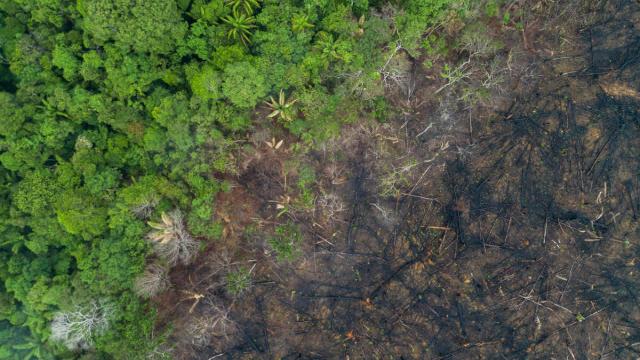
But how does global biodiversity loss and ecosystem collapse impact UK food prices and security? Well, if an ecosystem of global importance like the Amazon basin collapses, that would see it shifting to a drier savannah state. This would not only disrupt global supply of beef and soy but would release billions of tons of carbon, further warming our planet and impacting food production across the globe. And we are dangerously close to an Amazon tipping point. Around17% of the Amazon forest has already been destroyed through deforestation, and the latest science predicts that losing 20-25% of the forest would trigger eco-system collapse, turning the Amazon from rainforest to savannah. At which point, it would no longer function as a vital carbon sink or sustain the water cycle on which the region, and the world, depend. Our recent webinar presented key findings on how tropical forest stability underpins global food security and economic resilience.
Deforestation has long ceased to be just a problem for Brazil and the other countries in the Amazon basin but one the world can no longer ignore. Countries around the world need to be pitching together to solve this issue, by contributing to mechanisms such as Tropical Forest Forever Fund and greening supply chains to prevent further deforestation.
Another report surfaced in March from the now disbanded Defra Futures Team, which shares more warnings that climate change, habitat loss and geopolitical instability are undermining Britain’s food security to such a degree that it could be “at strategic risk of catastrophic failure” by 2030.
This is not a distant future, it’s happening now, in farms, shops and households in the UK and across the world.
There are lots of lessons the required food transition can learn from the clean energy transition. However, a clean transition for food is more complicated. It’s not just about how we produce but also about what and where, which we will explore in Part 2.
-
 © David Bebber / WWF-UK
Author
Sofia Parente, Head of Supply Chains Policy, WWF-UK
/
Have a question about this article?
Get in touch: policyinsights@wwf.org.uk