

Asian rhino:
4,014 greater one-horned, 34-47 Sumatran, fewer than 50 Javan rhinos left in the wild

Can be found:
Nepal, India and Indonesia

Threats:
Inbreeding, illegal wildlife trade
What sound do Asian rhinos make?
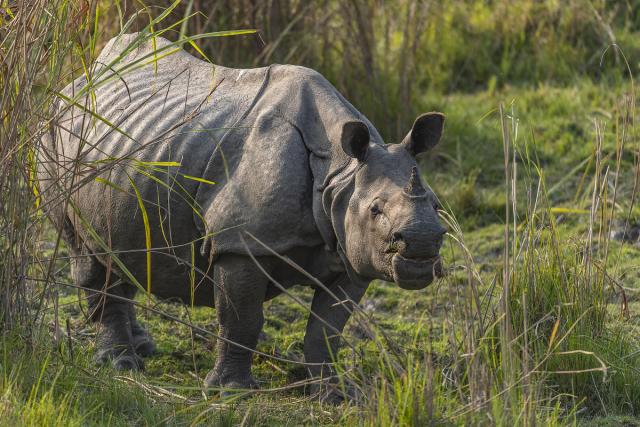
Greater one-horned rhinoceros recorded at Bardiya National Park (near Sivapur), Bardiya, Lumbini Province
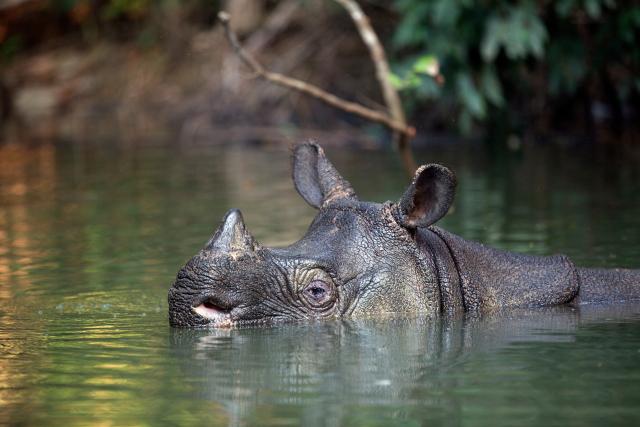
Asian Rhinoceros
Javan rhino (Rhinoceros sondaicus)
Sumatran rhino (Dicerorhinus sumatrensis)
Greater one-horned rhino (Rhinoceros unicornis)
Asian rhinos (greater one-horned rhinos in particular) have an even more armoured look than their African counterparts, thanks to all those folds in their skin. They graze on tall grasses and browse on shrubs, leaves and fruits – restructuring the landscape as they go.
They look pretty tough but Asian rhinos need a lot of protection right now. The greater one-horned rhino is slowly recovering thanks to years of successful conservation effort, but they’re at risk from habitat loss and fragmentation, poaching and human wildlife conflict. In addition, small and isolated rhino populations lead to issues of inbreeding and reduced genetic diversity.
The greater one-horned rhino once roamed across the northern floodplains of the India subcontinent, but now it’s found mainly in India and Nepal. The last remaining population of Javan rhinos are now only found in one protected area, Ujung Kulon National Park on the island of Java. Sumatran rhinos are found in Sumatra, with a few individuals remaining in Kalimantan, on the island of Borneo.
Why are they so important?
Rhinos have been around for millions of years and play a crucial role in their environment. They eat a lot of plants every day to meet their energy needs. So they are true landscape engineers.
For example, the greater one-horned rhino helps to keep the grasslands near rivers closely-cropped, which makes those areas attractive to smaller herbivores too. They also help disperse seeds in their poo, which help plants and trees spread.
By protecting the rhino we’re also helping other wildlife and people who depend on the health of that environment.
Key facts about Asian rhinos
What is the habitat of Asian rhinos?
Greater one-horned rhinos live in riverine grasslands and adjacent swamps and forests. [1]
Sumatran rhinos live in dense tropical rainforests, mainly in hilly areas. Javan rhinos live in lowland tropical rainforests.[2]
Javan rhinos live in lowland tropical rainforests.[2]
How many Asian rhinos are left in the wild?
There are around 4,014 greater one-horned rhinos in the wild.[3]
There may be as few as 50 Javan rhinos in the wild, found in only one population on the island of Java, Indonesia.[4]
There are estimated to be only between 34-47 Sumatran rhinos left in the wild.[4]
How big are Asian rhinos?
Generally Asian rhinos are around the size of a small family car.
Greater one-horned rhinos can measure up to 3.8m from head to tail and up to 2m in height. [5]
Greater one-horned rhinos weigh between 1,800-2,700 kg.[6]
The Javan rhino stands at 1.5-1.7m tall and weighs between 900-2,300kg.[7]
Sumatran rhinos are up to 1.5m tall and weigh 600-950kg.[8]
What do Asian rhinos eat?
Greater one-horned rhinos are grazers, feeding on mainly grasses but also some fruit, leaves, shrubs, tree branches and cultivated crops.[9]
Javan rhinos eat a wide range of plants; over 300 different species have been found in their diet.[7]
Sumatran rhinos are browsers and eat a wide range of plants including saplings, leaves, twigs, shrubs and fruits.[8]
What is the IUCN status of Asian rhinos?
Where do Asian rhinos live?
Explore the map below to see the IUCN (International Union for Conservation of Nature) range data for Asian elephants.[11]
-
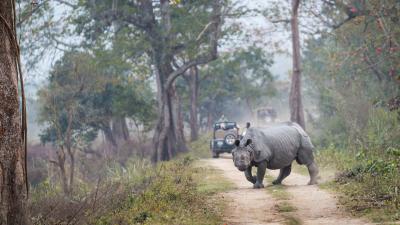 © Richard Barrett / WWF-UK
 -
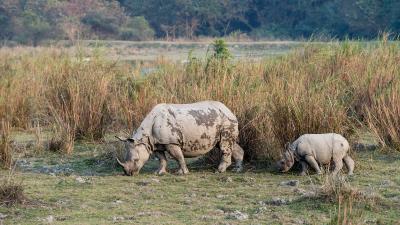 © Richard Barrett / WWF-UK
 -
 © Robert Patterson / WWF
 -
 © WWF-UK / Shutterstock / Parthbhatt

How we're helping
Together with governments, local communities and other NGOs we’re working to improve rhino conservation and management by supporting rhino monitoring, restoring rhino habitat, and identifying suitable habitats where rhino populations can expand.
Protecting rhinos from poaching:
WWF supports anti-poaching patrols, strengthens ranger capacity, and advances intelligence-led enforcement in key protected areas. These efforts are essential to reducing illegal activity and protecting rhinos in the wild.
Restoring and expanding habitat:
Agricultural expansion, infrastructure development, and deforestation have degraded critical landscapes, forcing rhinos into smaller, isolated areas. WWF works with governments and partners to restore habitats, maintain wildlife corridors, and translocate rhinos to suitable sites—measures that help reduce inbreeding and support viable populations.
Supporting local communities:
WWF promotes community-led initiatives that offer alternative livelihoods and reduce pressure on forest resources. Improved land-use planning and early warning systems also help reduce human-rhino conflict and support peaceful coexistence.
Monitoring and research:
WWF contributes to population surveys, camera trapping, and genetic research to inform conservation strategies. The organisation also plays an active role in regional and global platforms, including the Asian Rhino Range States meetings and the IUCN Species Survival Commission, ensuring rhino conservation remains a shared international priority.
Adopt a rhino
Adopt a rhino
Your adoptions will help protect rhinos in Asia and help fund our other vital work around the world!
We also recommend

Go Wild - WWF's Club for Kids
5 facts about black rhinos
Take a rhino quiz
World Rhino Day
Sources
- International Rhino Foundation | About Rhinos https://rhinos.org/about-rhinos/rhino-species/javan-rhino/ Accessed 01/11/24
- Ellis, S. & Talukdar, B. 2020. Rhinoceros sondaicus. The IUCN Red List of Threatened Species 2020: e.T19495A18493900. https://dx.doi.org/10.2305/IUCN.UK.2020-2.RLTS.T19495A18493900.en. Accessed 01/11/24
- Ellis, S. & Talukdar, B. 2019. Rhinoceros unicornis. The IUCN Red List of Threatened Species 2019: e.T19496A18494149. https://dx.doi.org/10.2305/IUCN.UK.2019-3.RLTS.T19496A18494149.en. Accessed 01/11/24
- Ellis, S. & Talukdar, B. 2020. Dicerorhinus sumatrensis. The IUCN Red List of Threatened Species 2020: e.T6553A18493355. https://dx.doi.org/10.2305/IUCN.UK.2020-2.RLTS.T6553A18493355.en. Accessed 01/11/24
- International Rhino Foundation | About Rhinos https://rhinos.org/about-rhinos/rhino-species/sumatran-rhino/ Accessed 01/11/24
- Rookmaaker, K. (2020). The The maximum size of the Greater one-horned rhinoceros (rhinoceros unicornis). Pachyderm, 61, 184-190. Retrieved from https://pachydermjournal.org/index.php/pachyderm/article/view/14
- Javan Rhinoceros: © IUCN (International Union for Conservation of Nature) 2020. Rhinoceros sondaicus. The IUCN Red List of Threatened Species. Version 2025-1. Sumatran Rhinoceros: ©IUCN (International Union for Conservation of Nature) 2020. Dicerorhinus sumatrensis. The IUCN Red List of Threatened Species. Version 2025-1. Greater One-horned Rhinoceros: © IUCN (International Union for Conservation of Nature) 2019. Rhinoceros unicornis. The IUCN Red List of Threatened Species. Version 2025-1. https://www.iucnredlist.org. Downloaded on 05/08/2025
- Ellis, S. & Talukdar, B. 2019. Rhinoceros unicornis. The IUCN Red List of Threatened Species2019: e.T19496A18494149. http://dx.doi.org/10.2305/IUCN.UK.2019-3.RLTS.T19496A18494149.en. Accessed 01/11/24
- International Rhino Foundation – September 2024 State of the Rhino Report https://rhinos.org/about-rhinos/state-of-the-rhino
- International Rhino Foundation | About Rhinos https://rhinos.org/about-rhinos/rhino-species/greater-one-horned-rhino/ Accessed 01/11/24
- International Rhino Foundation – September 2024 State of the Rhino Report https://rhinos.org/wp-content/uploads/2024/10/SOTR_091624.pdf